Saturday, March 25, 2017

                                                                                                           Written September 29,  2013
Do you wanna be a poet and write?

Do you wanna be an actor up in lights?

Do you wanna be a soldier and fight for love?

Do you wanna travel the world?

Do you wanna be a diver for pearls?

Or climb a mountain and touch the clouds above?

Be anyone you want to be

Bring to life your fantasies

I want somethin' in return

I want you to burn

Burn for me, baby

Like a candle in my night

Oh, burn, burn for me, burn for me
Songwriters
Sean Michael Anderson
Orlando Jahlil Tucker
Robert Rihmeek Williams

Mari wakens and wonders why her alarm has not broken the stillness as yet.  Quickly she spins the clockface towards her and sighs in relief that she the gift of an hour’s sleep remains.  It doesn’t matter.  Mari can’t sleep anyway.  It is too momentous a day. She slips from the covers and creeps down two flights of stairs contemplating the time this happened five years before. 
Then it was because her mother at age 88 was leaving.  The memories fold about her like the warmth of the quilt she just left behind.  She is still lying in the twin bed positioned adjacent to her mother’s full size bed, sobbing into the pillow. 
            “It was never supposed to happen this way.  You were supposed to live here until heaven called you home.”
            “It’s still not too late,” says Mom, “We can still change our minds.” 
            But that is stating the impossible.  When a river has been released, it can be channeled down one pathway or another, but it cannot be pulled back and re-harnessed in the same place.
            Today it is not her Mom, but her daughter. Mari wants to climb into that full size bed beside her baby daughter, now age 25.  She wants to cradle her in her arms the way she did years ago, stroking her curls, synchronizing their breathing, and savoring each moment in the wee morning hours of solitude when no one was about to disturb the moment.  In infancy Mari rocked her in the red rocking chair, recognizing that this was the last of her babies, every sigh, every heartbeat, every coo was to be savored, to be imprinted on this mother’s heart.  It was Mari’s goal that the unspoken love overflowing in her heart would find expression in the physicality of a mother/daughter hug.  That hug would have to linger for four months until Chryssa would return again.  But when Mari reaches the bottom step, she finds the bedroom door closed.  The wondrous peace of the nighttime’s calm is palpable and she cannot conjure the nerve to disturb it.  She knows Chryssa is resting right inside that bedroom door, but to turn the handle would be to disturb the calm for which lullabies were created.  Why begin the separation steps of the day any earlier than needed.  Instead Mari hears the dryer humming, one last load that Chryssa has set in motion to be ready for the coming day.  Mari allows the dryer to be her vehicle of action.  She folds the few items, a routine repeated over and over in the many years of child-rearing, as a standard and reassuring act of motherly love.  Chryssa will have one less thing to do in the morning.  Mari smooths the shirts and shorts as if caressing Chryssa’s cheeks.  She lays the patted pile in a position where it will be easily visible in the morning.  She steps back into the hallway and blows a kiss through the bedroom door, tiptoes back up to the third floor and repositions herself next to her husband as if she had never left.
            At 2:30, the alarm chirps repeatedly.  This time it is not as easy to gather the ambition to rise from slumber.  Mari snoozes a few extra moments before bounding out of bed and leaping down the stairs to offer help.  Bill is already in the kitchen, dressed and brewing a cup of coffee.  He acknowledges Mari’s appearance, but she is already halfway down the second flight of stairs to Chryssa’s door.   She opens it to find a bright beam of the bathroom light flooding the space and Chryssa hefting a 50-pound suitcase onto the scale for the 3rd time to verify that it will make weight.
            It has been a marvelous three days.  Chryssa arrived Thursday from California to spend the long weekend with her family before departing for Uganda.  On Friday, Mari had invited many of Chryssa’s high school friends and their parents to relive some of their precious Holliston memories.  It was a lovely gathering of about 25 friends, all of whom brought a gift of encouragement or some special words of wisdom to share before her departure.  It mimicked many similar events of years past, such as graduation nights, prom nights, senior class play nights, and softball team picnics.  The barbeque, salads and desserts created the aura of encouragement and fun that carved right through the palpable worries.  Every guest was so proud of the adventure Chryssa had elected to take on next.   

            The questions were the same from everyone.  Why was she off on this adventure?  Her husband remained behind in San Francisco, but Chryssa had committed to spending a full year in Uganda.  Was there a problem in the marriage?  Did they need some time away?  Was Chryssa running away from the fear of managing a demanding accounting job with a top firm?
            "You're raring to go!" said Mari.  In her mind she was wondering how she could share her fears of sending her daughter off alone to a third world country when she was a beautiful, but light weight 27 year old female.  The possibilities for danger seemed overwhelming.
            "Why not?" retorted Chryssa.  "I've been planning this for 3 months."
      

Wedding Day 1978

Wedding Day 1978


Mari's eyes fluttered open. Her first year of teaching school had just ended the week before.  Finally the day she had prepared for all the year through had arrived.  All was as it should be.  This was the day that would change her life. 

Mari stretched out in the full sized bed, surprised that her sister, Theresa, was already up and about.  In the three bedroom home, they still shared the same bed they had since Mari was a freshman in high school.  When Mari went off to college, it gave them each space to find their own way. Today it was especially helpful to have a younger sister who could help with all the unexpected details of the day.  It had been a while since a wedding had occurred in their family.  Nine years to be exact. All her older sisters had their own children to attend to on this day, but Mari liked that this gave her younger sister a special place of honor as the lone related bridesmaid for today.  Theresa was almost seven years younger, and anxious to be thought of as the oldest in the household for a change. 

Mari slipped out of bed and sauntered to the kitchen.  

"Here she is.  Are you ready for your big day!" asked Mom. 

"Sunny outside, but some clouds, too," someone mentioned.   It was hard to quickly catalog the group of people assembled at the kitchen table. 

"Eggs and bacon?"

"Not today.  Not much of an appetite on my wedding day?  I'm going to hit the shower.  Are Nadene and Barbara awake yet?  We have to be ready for our hairdressers appointments shortly. 

The morning sped by with little fanfare.  Mari went off to the hairdressers with two of the bridesmaids.  She had a manicure the night before, only the fourth on in her life other than prom nights through her schooling years.  Mom and Theresa stayed home to greet strivers, answer phone calls, guide any quizzical guests, and verify last arrangements with the florist and venue. By noontime Mari and her ensemble were ready and waiting for the photographer and flowers to arrive.   

There was an unscheduled interlude between activities when Mari selected a comfortable arm chair and stared out the window. It was easy to become reflective.  Had she made the right decision?  She knew Bill was a wonderful opportunity.  Their courting years had shown how they were both committed to helping others first.  How could one go wrong with a man like that.  Had her Mom made the right decision?  If she could go back in time, would her Mom retrace the same steps again? Her mother was the strongest influence in Mari's life.  Of course, reviewing her plan of action meant reviewing the example that had been set. Mari knew that her inexperience meant she should look to others wiser for guidance, but she also knew she had chosen wisely and had assembled a winning hand.  Now it was time to let fate play its turn.  How long and lovingly she had awaited this day. 

The sound of the doorbell tugged her back from her introspective silence.  She willed herself to stand as the photographer entered the living room.  Other persons would now direct the day and Mari would flow with the currents agreed to in the prior months of wedding planning. For the next hour smiles, staged still-life's, and sentimental hugs would become the family photos that would grace many homes in the years to come. 

From the living room bay window Mari could see the wedding vehicles arrive.  

"Where are those flowers?" her maid of honor and college roommate queried.  Everyone was in a bit of a panic as it was time to be on the way. 

"I don't know but I thought we would get excellent service. After all Bill worked at this florist through his high school years and he knows all the designers."

Just as Mari picked up the corded rotary house phone, the delivery van parked at the front door. There was a flurry of boxes, questions, answers and exchanges until graciously and surprisedly each had their own adornments. With her eyes beginning to well but consciously abating her feelings, Mari pinned on Dad's boutonnière while Theresa slipped on Mom's wrist corsage. Then all flooded into the assembled cars to head off on this magical journey. St. Catherine of Siena Catholic church was just 10 minutes away, but it held all the wishful moments of this young girl's heart, who had been taught that a soulmate and children were the keys to the floodbank of happiness for all the years to come.  

"You look beautiful," was a recurring comment as Mari's future in-laws greeted her at the church and whisked her into the bride's waiting room.  No longer did Mari's feel the pings of doubt once she arrived at the church.  This was going to be an easy wedding.  

Mari's family had already been through 3 weddings so they knew the lay of the land. The first two sibling weddings had been consecrated under challenging circumstances, but the most recent one had been a joyous and traditional celebration.  Mari had the good fortune to be the second such wedding, so her family already could anticipate the days schedule and embrace the fun to come. 

The pipe organ coaxed Mari down the aisle, but kissing Dad goodbye and sliding her arm into Bill's steady grip was automatic.  

"Do you take Bill to be your husband?"

"I now pronounce you man and wife."

The details were short, simple and deeply emotional.  

It didn't matter that the reception was a lovely success, attended by all that were invited.  What mattered was the promise made this day and the conviction that this new path was their life-long journey.  

Wednesday, August 19, 2015

Prism Perspective: Preamble

In the story to come, I shall call myself Mari.  It is not my real name, but will be my character name in the story.  Somehow there is a comfort to distancing myself so I can tell the story from no singular perspective.  A family story is really the richness of many persons' life journeys and perspectives.  I begin to host this story, as I was Nick's primary caretaker in the last years before his death.  It was something I formally committed to at about 21 years of age.  My parents asked me and my  husband to become Nick's caretaker in their elder years, as I had studied to be a special education teacher and my husband was Executive Director of the local ARC (Association for Retarded Citizens).  Though this was posed as a choice for me,  I could not even fathom any alternative.  Of course, I would be there to support Nick in whatever he needed throughout life.  That message had reached my heart many years before when I was born the younger sibling of a brother who life paralleled with mine in so many areas.

Prism Perspective, Chapter 3

                                            His Quiet Presence


         As a little boy, Nick was a pleasure to his siblings.  Being so medically involved and not ambulating until age 4, Nick posed no threat to toy ownership, vying for dinner table food, or selecting leisure activities for the evening.  When younger sister, Mari, began to walk at one year of age, older sister Diane found it intolerable that Nick could not do the same.  She made it her singular objective in her time spent with Nick to practice his steps regularly long before the days of baby walkers.  Through her persistent efforts, Nick did learn to ambulate.  However, he much preferred sitting cross legged, with each leg completely circumventing his hips to provide stability in the vertical position.
          Television was just gaining popularity in the late 1950s.  Nick could position himself six inches from the TV set, which was the limit of his visual clarity, and revel in the newest TV shows including Bonanza, Leave it to Beaver, Perry Mason, Jack Benny, the Ed Sullivan Show, and Dennis the Menace.  Once his dinner was swallowed, Nick would settle in his cross-legged position for a two hour stint, with no arguments about channel selection since choices were limited.  Then it was bath time and bedtime so that Margaret could tuck the others into bed once Nick was settled for the evening.
          Bedtime always started in the kneeling position doing choral recitations of nightly prayers.  "Hail Mary full of grace,"  or "Our Father".  It was a precious sight to behold, children of all ages in their comfy night clothes, kneeling side by side with Mom and Dad, enjoying this religious ritual.  Once in bed, all three children were kissed good night while the three older girls finished their homework in the living room.


Thursday, August 13, 2015

The Prism Perspective Summer 2015

Today provided a wonderful leisure summer afternoon.  As a teacher, days such as these are sparse and much revered.  I noticed one of the boxes of memories I have stored for years and wondered if, at age 58, this was a good time to revisit these moments, this time knowing the outcome.  By happenstance, the box I selected was my husband's first love notes during our college years.

What quickly becomes apparent is that our love was built on a foundation of spiritual faith.  I didn't remember that clearly, but the letters remind me what a priority that was in selecting a soulmate.  Our relationship was also based on a mutual interest in helping those differently abled.  Bill and I met at a Thursday night recreation program for special needs adult and our first date was August 1975.  We were both to begin our junior years in college in September.

On September 11, 1975, Bill writes, "I haven't really known you for all that long, but the love that I see you give to those less fortunate has overwhelmed me to a point of admiration. "   Six days later he shares that "Saturday after the game some kids from the Pennsylvania ARC came over to visit.  We had a great party.   My fraternity is hosting an activity night for them on October 2.  We are planning a magic show and a dance.  I can't wait."

October 15, "Mari, we have both learned through working with special needs adults that love radiates from their hearts.  To me this love is different than any I have ever known.  I've done some pretty sentimental thinks in my life, though each and every time it's been while working with special needs children."

In January 1976, Bill wrote me that he had acquired a work study job at an alternative school connected with his university, Lehigh University and that he was thrilled to be assigned to a classroom, "possibly helping to teach."  He did teach some content that year and it helped him earn credits toward his Lehigh degree.

Bill and I were not exclusively dating just each other at that point, so since we had both returned to our separate colleges, I wrote, "I loved the book you sent, Bill.  It offered guidance on the last page.  'God speaks to us sometimes through our circumstances and guides us, closing doors as well as opening them.   He will let you know what you must do, and what you must be.'  I know that I can't make a decision right now as to who is best for me.  Someday the Lord will make that decision for me.  I've been praying that the Lord will lead me to the spouse that He has picked for me.  It's been a long road so far--enjoyable but sprinkled with heartaches.

'Deliver us, O Lord, from the foolishness of impatience.  Let us knot be in such a hurry as to run on without Thee.  We know that it takes a lifetime to make a tree; we know that fruit does not ripen in an afternoon and Thou Thyself didst take a week to make the universe.....  Slow us down, O Lord, that we may take time to think, time to pray, and time to find out Thy will.  Then give us the sense and the courage to do it."

I made the right decision.  On June 24, 1978, I married my soulmate, though it took many years to know that for sure.  Clearly, God chose for me someone that helped me carry the burdens of raising a special needs sibling.  That path evolved slowly, just as a path through the woods has many forks where choices can be made.  It began in 1984, two years after the birth of our first children, twin boys.  My parents knew we would appreciate more space than our townhome for raising children and offered that we could build in the empty lot they owned beside their home if in turn we agreed to assume responsibility for raising Nick if they became unable to do so at any time.  It seemed like a no-brainer to Bill and I in terms of making that decision.  We were going to be there for Nick no matter what that entailed, so getting a larger home in the bargain was a delightful bonus.

For 10 years we raised our family of 3 children side by side with my parents.  We shared many daily tasks together, including yard work and driving to appointments.   Then in June 1993, my father, Nicolas Dugan, passed away of a heart attack.  That fork in the path had a clearly marked arrow sign and we did not hesitate to follow its lead.


Saturday, February 23, 2013

A Sibling with Special Needs

                       What is our strength is our weakness, what is our weakness, our strength!

Welcome to my blog about my brother.  I was the younger sister of Nick, by 3 years.  Because of him, I served in all the following roles:  sibling, babysitter, special education teacher in pull out programs and integrated classrooms, special education administrator, power of attorney, primary caregiver, medical proxy, and group home advocate.   Nick passed in May of 2012 at age 59.  He wasn't supposed to live past 12.  Hey, docs, that is fulfilling his life expectancy five sequential times!!  Nick taught me more about love than any other person.  He taught me about the depth of my love and how resolved that could be in very difficult situations.  He taught me about family love and how much it means just to be together.  He taught me the power of community and of building a community around a loved one.  Through this blog I hope to touch and teach others.  I want to touch others with the power of a beautiful story.  I want to teach others how to gather supporters around you instead of citing legal ramifications and plying others into providing for your loved ones needs.  It is a powerful story that keeps surprising me by its intensity, yet it is a typical story, because we all have family burdens and family gems.  I hope you will enjoy and participate.  We have so much to learn from each other!  Let the journey begin!

I am writing Nick's book one chapter at a time.  I will sort them out later, as they may not be written in sequential order.  Look at my blogposts labeled "The Prism Perspective" to read this story as it evolves!

Friday, February 22, 2013

The Prism Perspective, Chapter 1


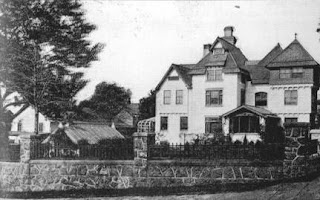
    The George Holton home at the corner of Pine and
    Second Street, Catasauqua, PA

    Fulfilling the Family Dream
    Irish immigrants began to arrive in Lehigh County, Pennsylvania in the early 19th century, with a significant influx occurring in the 1840s and 1850s. Many of these immigrants were fleeing the Great Famine in Ireland, and were attracted to the area by the prospect of work in the local iron mines and textile mills. The Irish settled in the cities of Allentown and Bethlehem, as well as in smaller towns and villages throughout the county.
    As the Irish community grew, it began to establish its own institutions, including churches, schools, and social clubs. The Irish-American community in Lehigh County was particularly active in the labor movement, with many immigrants working in the coal mines and textile mills and joining unions to improve working conditions. The community was also politically active, with many Irish-Americans being elected to local office and serving in the state legislature.
    Despite facing discrimination and prejudice, the Irish-American community in Lehigh County established itself as a significant and influential group. They made welcome contributions to the economy, culture and politics of the county.  
    Patrick Dugan was born in 1842 in Ireland. His father, Locklon, was 37 and his mother, Sarah, was 29. By the age of 8, Patrick’s family had emigrated to the United States and resided in New Hope, PA in 1850. He married Mary A Willoughby (also spelled Wilby) in 1879 when he was 37 years of age and they had four children together, John, Laurence, Eddy and then Nicholas John Dugan born, on May 18, 1884 in Copley, Pennsylvania. Patrick died in 1884 in Pennsylvania at the age of 42, and was buried in North Catasauqua, Pennsylvania. Mary Wilby remarried Bernard O’Neill and had 2 more children, Emma and James O’Neill. Mary died on March 30, 1942, in Catasauqua, Pennsylvania, when she was 81 years old.

    George Holton was an officer of the Bryden Horseshoe. He was one of the rich industrialists of Catasauqua that enjoyed flaunting his wealth by building a prominent estate (1).
    George traveled nationwide securing orders for his product. His most successful order involved the weekly train-car delivery of horseshoes to the British Government during the Boer War, 1899-1910. This transaction kept his Catasauqua factory running at full tilt, catapulting the Bryden facility as one of the largest industrial leaders in the Lehigh Valley. His success was likely a prominent reason that George Holton was favored by the boss’s youngest daughter, Jessica, and they married and had three children.
    Nicholas James Dugan was a young man when he was hired on by the George Holton family as the family chauffeur. He was already a talented machinist, having developed his skill by working for the Atlas Cement, Bethlehem Steel, Lehigh Portland Cement, and Thomas Iron Works. He was bright and conscientious and eager to learn the modern technology of the decade. Nick was glad to trade the confinements of a factory line position for the chance to strut one of the first motor cars around town.  
    Nicholas’ excursions around town likely attracted the attention of the young ladies. In May 1908, Nicholas married Margaret Lynch, also from Catasauqua. Evidence of their strong attraction to each other was the birth of their first child, Loretta, on October 3, 1909. They were smitten.
    Working for the Holton’s was a sure thing through these early years, and offered unique opportunities. In April 1911, Nicholas parlayed his mechanical talents into an entrepreneurial enterprise with George Wentz. They opened the first car-repair garage in town, catty-corner to the Holton home. On April 7, 1911, the Allentown Morning Call reported, “A general garage for the storage and repair of automobiles, motorcycles, bicycles, etcetera will be opened next week in the building formerly housing the merry-go-round on Bridge Street near Front by Charles Wentz and Nicholas Dugan. Messrs. Wentz and Dugan have purchased the stock and fixtures of a Weissport garage and will have them here by the forepart of next week. Mr. Dugan, who is an experienced machinist and and practical chauffeur will have charge of the repair work. He is well qualified for this position, having been in the employ of George Holton in his private garage for the past several years.”
    In July 1911, George Wentz sold his interests to Nicholas’ brother-in-law, Philip Lynch, who declared similar mechanical interests. Above the indoor garage on 115 and 117 Pine Street, Philip and Nick incorporated two apartments for each of their respective families. Philip moved in with his lovely and cultured wife, Annie, and on January 27, 1912 Nicholas and Margaret set up their residence in the adjoining apartment. Now after breakfast, the men simply had to amble downstairs to attend to their business of storing and grooming cars and providing cars for hire.  
    Though this partnership enjoyed cutting edge timing, it had its challenges. On December 6, 1912, the Allentown Morning Call reported, “As a result of a series of accidents, both members of the firm of Lynch and Dugan, proprietors of Catasauqua Garage are suffering from fractured limbs. A week ago, Nicholas Dugan, while cranking an automobile belonging to George Holton, president of the Bryden Horse Shoe Works, was struck on the wrist with the handle and the bone was broken. Five days later, a like fate befell his partner, Philip Lynch, who was struck on the leg by the crank of an automobile. His knee cap was dislocated.” These physical injuries were common occurrences in the hands-on, factory type business models of the early 1900s.

    All was going along swimmingly for Nicholas and Margaret when their daughter Loretta was born in October 1909. Along with cherishing their daughter, they raised white orpington chickens and showed them in farm competitions. Loretta was well coifed for town outings with the family. The family of three enjoyed potluck meal, storytellers who visited the garage, trips to the Catty Park for community outings, music from local entertainers and possibly hayride in the fall. As Loretta became school age, they likely spent evenings playing cards, marbles, checkers, jacks or chess. They looked forward to expanding on their wealth and success, however, in 1916 they lost a daughter who survived just 3 days.  
    Nicholas and Margaret were survivors. When the going got tough, they pulled up their bootstraps and rallied ahead. On September 27, 1917, the Morning Call reported, “Mr. and Mrs. Philip Lynch, Mrs. Susan Lynch, and Mrs. Nicholas Dugan motored to Bridgeport (a section of Philadelphia) and spent the forepart of the week with relatives.” Clearly, their comings and goings were Allentown newsworthy features to be read by other Lehigh Valley citizens.
    On October 17, 1918 Nicholas and Margaret experienced another miscarriage. This was just at the time that Pennsylvania was being struck by the Spanish Flu. The 1918 “Spanish flu,” killed 60,000 people in the state of Pennsylvania alone, with an unusually high death rate among healthy adults 15-34 years of age, atypical of most epidemics. Pregnant women were at an even greater risk for complications. Philadelphia was especially hard hit due to the dense population and the presence of 300,000 additional wartime workers. Many residents, specifically poor and working-class immigrants, lived and worked together in crowded, unhygienic conditions. Doctors and public health officials did not understand the cause for the disease nor did they have the medical advances to effectively combat it. Beginning in October 1918, schools and public meetings began to be banned, though for short periods of time, perhaps two weeks duration. Public health officials underestimated the severity of this contagious disease and overestimated their ability to keep it contained. To complicate matters, 75% of Philadelphia doctors and nurses had been called away to the war effort, putting even more strain on local hospitals. (4).
    With hospitals and medical facilities overwhelmed with patients, in many cases, medical staff were challenged to keep accurate records of births and deaths. The sheer number of patients they were treating daily impacted their ability to maintain the paper trail. Additionally, local government offices experienced so many employee absences that they could not keep track of births and death records. Many babies born during this time period were not officially recorded. Families were also separated or displaced during the pandemic, making it difficult for parents to register the birth of their child. The flu came on so unexpectedly and since healthy adults of child-bearing years were the most hard hit, mothers and fathers died from the flu before they could register their child’s birth. The lack of a birth certificate presented significant challenges for the orphan. Without official documentation, the child was unable to access government services such as social security, healthcare, and retirement. It was a problem that would continue to haunt them for the rest of their lives.
    Yet in November 1918, Margaret and Nick decided that adopting a daughter of unknown birth would help them recover from the loss of their own baby just one month prior. They joyfully received their precious baby daughter right before the holiday season, a true Advent and Christmas gift for a faithful Catholic couple. As a toddler, Margaret’s youthful joy revived Nick and Margaret’s spirits and helped them re-engage in the joys of family life. Yet soon after the winter of 1919, Nicholas became seriously ill with pneumonia. His illness was published in the Allentown Morning Call again, perhaps so his customers could predict his availability. It was truly a “peaks and valleys” time, with the successes and setbacks. As Nick recouped from his illness, he likely doted on both his daughters, whose age differences made their interests quite diverse. When news came that Margaret was expecting again, they were cautious but elated. Never did they expect that midway through they pregnancy they would lose their eldest and first born child, Loretta, in February 1921. The entire town showed up for the burial, a situation that mimicked every parents’ worst nightmare. Just three months later, in May of 1921 their next child arrived in 1921, a beloved son, Nicholas Joseph Dugan. His name reflected the changing of the guard. Though he was given the first name of his father, he maintained his upcoming individuality with his alternate middle name.
    Nicholas James and Margaret were well revered in local society. Their social ventures were noted in the newspapers. Nicholas was honored by the Catasauqua T.A.B. for increasing their membership in one year from 125 to 200. The 75 new members added a vitality to the social gathering hall that sported basketball courts, boxing matches, and local pick up team challenges. T.A.B. members were mostly Irish Catholics from St. Lawrence Church. Nick relished being a leader amongst his peers, particularly since he was the boy raised without a father. His well suited spouse rallied interest from others about their daily activities. They were an unusually successful couple who enjoyed trips to Philadelphia and Weatherly, picking up cars for the business, visiting relatives, and flaunting their transportation successes.  
    In the quiet of the evening, they mulled over financial records and put their babies to bed. Baby Nicholas was spoiled with the new Teddy Bear, which Margaret carried around more than her brother could. Occasionally, the adults enjoyed a bit of illegally acquired moonshine and continued their attempts to conceive and another infant. Another bout of joy and sorrow when Mary was born prematurely at 7 months on April 1, 1923 and died the same day in the hospital. This time a burial was required, so a coffin was purchased and Mary was set to rest in North Catasuaqua cemetery.
    Still the Lynch Dugan business prospered. In 1923 they purchased the property across the street from their original garage. (2) The site at 120 Pine Street, Catasauqua, was originally a blacksmith shop, but consumer interest was shifting from wagons, wagon wheels and horseshoeing to the amazement of the automobile. The open porticos of the blacksmith building became perfect wide-berthed window enclosures, perfect for a showroom for their Ford Motor Company vehicles.  
    Nicholas and Marguerite were committed to growing their family. Susan was added to the family on July 2, 1924. Early in Susan’s life, epilepsy reared its ugly head, causing increasing blindness as she aged. The final blow to their family union was when Nicholas James contracted pneumonia and died in 1925.  
    Nicholas’ widow, Margaret, valiantly assumed his position alongside her brother Philip Lynch, making trips to car shows in Philadelphia, quite an unlikely action for a woman in those years. In response to their challenges, they tried shifting manufacturers to Hudson/Essex, then to Flint/Durant/Star and in 1928 back to Ford. Raising three children while maintaining a business was no easy task. In 1932 they discontinued the car sales and continued with just auto maintenance. Philip and Margaret held the business together until Nicholas Joseph Dugan was old enough to begin work, sometime in his teen years.
    Nick, Jr. pumped gas, listened to the men in the garage office sharing stories over the cold soda machine, and learned the automobile trade. It was a struggle to be grounded for a teen with no dad, and Nick did not graduate from Catasauqua High School, yet revered the value of education for the remainder of his life. Nick was content to be homebound until 1942. Peers were drafted to the war when the United States responded to the Pearl Harbor tragedy. Nick was given a military waiver so he could maintain the business and provide for his family. Yet the national spirit of males his age was to contribute to the war efforts. By 1943 Nick could no longer remain at home with a good conscience. He signed up for duty and off he went to England.

Footnotes
1 HTTP://HIMEDO.NET/THEHOPKINTHOMASPROJECT/COALFIREIRONSTEEL/APPENDICES/CATASAUQUAINDUSTRYRESIDENCES/
CatasauquaIndustries/Bryden.htm

2. Historic Catasauqua Preservation Association.  HTTP://HISTORICCATASAUQUAHCPA.ORG/PINE-ST-BUSINESS-AND-RESIDENTIAL-PINE-ST-BUSINESS-DISTRICT/

3. Morning Call, Friday, December 6, 1912, Page 14.

4. Shetty, Mira, 2018, Penn and the 1918 Influenza Epidemic DOI: HTTPS://ARCHIVES.UPENN.EDU/EXHIBITS/PENN-HISTORY/FLU/CONCLUSION/

Mary Beth Numbers, December 09, 2022